C103 - The Semiotics of Advertising
Week 13, Asynchronous Bundle 13
Written assignment due Friday 11/21 at 11:59 pm
Introduction
- Goal: Explore intertextuality among both advertisements and other genres
- Textbook connection: Chandler, chapter 6, esp. 253-62.
Asynchronous material
Q1:
- Let's start with one of the most famous ads ever made, originally shown only once, at the 1984 Super Bowl.
- This is based on George Orwell's dystopian novel about Communist autocracy, originally published in 1949.
- Some of you will have read this novel, a few might have seen one of several film adaptations, but even a person who hasn't read it is likely to be familiar with it and understand generally what it is about. It has penetrated pretty far into our culture. If you are NOT familiar with it, I recommend that you google it and read at least part of its Wikipedia page.
- Apple
1984 commercial
- Here's the text of what Big Brother
says in this ad: "Today,
we celebrate the first glorious anniversary
of the Information Purification Directives.
We have created, for the first time in
all history, a garden of pure ideology,
where each worker may bloom, secure from
the pests purveying contradictory thoughts.
Our Unification of Thought is more powerful
a weapon than any fleet or army on earth.
We are one people, with one will, one
resolve, one cause. Our enemies shall
talk themselves to death and we will
bury them with their own confusion. We
shall prevail!"
- Compare this text from George Orwell's 1984 (the bold part is used on the sountrack of the ad): "My
friends, each of you is a single cell in
the great body of the State. And today,
that great body has purged itself of parasites.
We have triumphed over the unprincipled
dissemination of facts. The thugs and wreckers
have been cast out. And the poisonous weeds
of disinformation have been consigned to
the dustbin of history. Let each and every
cell rejoice! For [t]oday,
we celebrate the first glorious anniversary of the Information
Purification Directive! We have created, for the first time in
all history, a garden of pure ideology, where each worker may
bloom secure from the pests of contradictory and confusing truths.
Our Unification of Thought is a more
powerful weapon than any fleet or army
on Earth. We are one people. With one
will. One resolve. One cause. Our enemies
shall talk themselves to death. And
we will bury them with their own confusion.
We shall prevail!""
- Here's the amusing
parody of this ad that an amateur Barack Obama supporter
made in 2008 featuring Hilary Clinton as Big Brother
- Here's another parody involving the Microsoft-Apple computer
wars
- Q1: Who is the target Apple is attacking in its Super Bowl ad, and what is Apple saying about them? What does invoking George Orwell's novel do to further the message? How is the chief Apple representative in the video set up to contrast with the target?
Q2:
- Let's move on to something with a real sense of fun
- This is a chain of three related texts: feature film --> music video --> advertisement
- Start with the middle link of the chain, which is presumably the most familiar of the three texts to people of your generation: the music video for Fountains of Wayne's "Stacy's Mom"
- Here's the original source material, from the excellent 1982 teenager film Fast Times at Ridgemont High. It is probably enough to know that the boy in the video (played by Judge Reinhold) has an unrequited crush on the girl in the red bikini (played by Phoebe Cates)
- And here's a Dr Pepper ad that builds upon the music video, but also subverts it.
- Q2. There are two texts here which build meaning upon intertextual relation : the music video resting upon the original film material, and the Dr Pepper ad depending upon the music video, especially. Tell us what the advantage to the ad is to base it on a music video that was (presumably) familiar to a large portion of the audience at the time that ad was released. What meaning and/or emotional resonance does it draw from the video? Are there any traces of the original source material (from the 1982 film) still noticeable in the ad?
Q3:
- Here is another cluster of intertextually related materials leading to a couple of excellent ads.
- Start by watching a 7-minute clip from the very beginning of the 1970 film Patton, starring George C Scott in an Oscar-winning performance as the World War II general George Patton. This was an outstanding film at its time, and would be familiar to a lot of TV viewers who would be exposed to ads building upon it (mostly not of your generation, of course)
- Now here is a small snippet to watch from another film many of you are likely to have seen as children: Small Soldiers (1998).
- Many viewers of Small Soldiers will be children, who won't be familiar with the original source, so this will have no additional resonance for them. But then here is a question to contemplate (not as a written assignment): what do you think the point is to deriving so many details in this scene from a major Hollywood movie?
- Now here is a Nike ad that has a very direct intertextual relationship to this scene from Patton. The actor playing a football fan may be familiar to you: Dennis Hopper, known especially for over-the-top performances as crazy people (for example, he was the mad bomber in the 1994 thriller Speed)
- Finally, here is another ad that I believe refers intertextually again to Patton, though less obviously, for Molson beer.
- Q3. The Nike ad refers to the original scene from Patton in multiple ways. Enumerate at least five specific points that unmistakeably derive from it. What extra meaning does it give to the ad if a viewer of the ad recognizes and remembers the original scene? The Molson ad is less clearly derived from Patton. Make the case that it does have an intertextual relation to Patton. Give at least three arguments that it does (i.e., points of coincidence between the two videos).
Q4:
- Sometimes intertextuality can go badly wrong: if the full interpretation of the text depends crucially upon recognizing the original textual reference and connecting it up.
- Here is an ad for a Saturn car, not all that old, which fails in this respect. Watch the ad now before going any further on this page. I wonder how many of you get the original reference with no help from me?
- It makes intertextual reference to John Boorman's excellent 1972 film Deliverance. Few of you will have seen it, I expect, but it also has a broader presence in our culture that you might have encountered without knowing much about the original movie.
- Here's a fan-produced "modern trailer" for the film to give you an idea what happens in this movie. If you prefer to see an original 1972 trailer, you can find it at IMDB.
- Here's the most famous scene in the picture, with distinctive music that has become even better known than the film it comes from (it is actually a variant of a common bluegrass musical idea known as "Dueling Banjos", but it is presented very effectively in the film).
- It's weird that they would make a fairly recent ad referring to a 40-year old film. Although, come to think of it, I just ran across this on the internet by coincidence quite recently.
- Q4: First, tell me whether you got the reference and understood the significance of the musical snippet the campers heard in the Saturn ad, and understood immediately why they freaked out and fled. Second, if you did get the reference, did you get it through direct knowledge of the source movie, or through secondary associations it has taken on in our culture? Finally, tell me why you think they made this ad. What's the point of introducing a reference to Deliverance in an ad trying to sell a car? And how do they expect the ad to work if the viewer does NOT get the reference?
Q5:
- Here is a very famous clip from Alfred Hitchcock's 1960 thriller Psycho: the shower murder scene. It is an example of the montage style of editing (which will be highlighted in the next bundle), putting together a lot of very short snippets of film to achieve a greater effect via their syntagmatic juxtaposition. Here I'm interested in the content rather than the style (it was pretty gruesome and shocking for its day, 60+ years ago, although it plays as pretty tame today). One other piece of information is noteworthy to contextualize this clip. In the film Psycho, the first half hour is devoted to the character in the shower in this scene (played by Janet Leigh, who BTW was Jamie Lee Curtis's mother in real life). Then he kills her off, one-third of the way through the movie. When you watch the film for the first time (and I apologize for the spoiler; it is still well worth watching!), this is quite astonishing, and I'm not aware that any director had ever done anything like that in a major Hollywood movie: killing off the main character before the movie is even halfway done. The story then heads in another direction, and we wind up following two other characters who investigate the disappearance of this woman.
- Naturally, there are ads which relate intertextually to this very well-known scene.
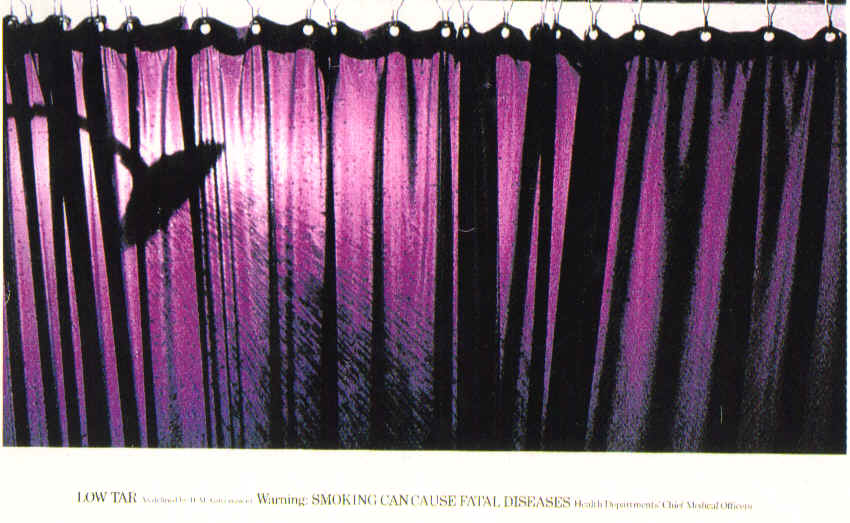
- Here's a Silk Cut ad which would be meaningless if you don't recognize the reference to this scene.
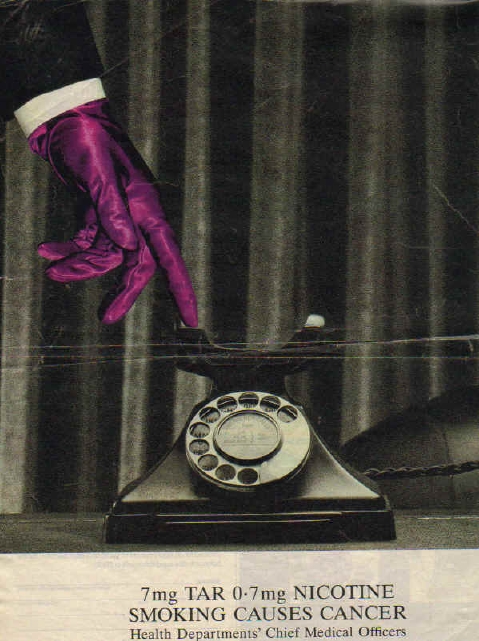
- Silk Cut produced a number of intertextual ads in that long-lasting campaign you've considered before. Here's another one that some of you might be able to puzzle out (though the source is from the 1950s). If you give up and want me to identify the source, send me an email asking about it. Hint: the source is another Hitchcock movie.
- Here's an ad for a breakfast cereal that references this film (not this specific scene, but the full story), though by featuring the actor who plays the murderer in the movie (you don't see him clearly in the shower scene). Can you spot the lone very brief reference to the shower scene in this ad?
- Or another breakfast cereal ad, this time referencing the scene more directly.
- Here's an undistinguished ad for Terminex (an exterminator company)
- Another completely boring, rather similar ad for a plumbing company
- A relatively clever ad for a student film festival.
- Q5. Take the Silk Cut ad relating to Psycho and explain how the intertextual reference works with the theme of the Silk Cut advertising campaign. Then take any one of the other ads referencing Psycho and explain how the intertextual reference works with its message.