C103 - The Semiotics of Advertising
Week 10, Asynchronous Bundle 4
Written assignment due Friday 10/31 at 11:59 pm
Introduction
- Goal: clarify the distinction between the two models of the sign.
- Textbook material: Ch. 1, 13-39.
- For Q5 on "non-reality", you could consult Ch. 1, 55-57. You weren't asked to read Chapter 2 in Chandler, which this question is related to, but if you want to visit it, you could take a look at Ch. 2, 78-89.
Asynchronous material
Q1 and background information starts here:
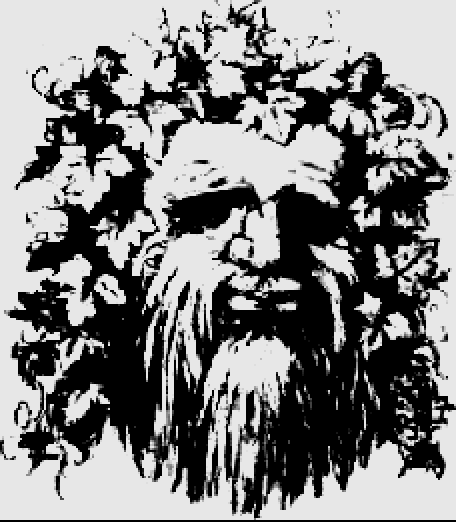
- An optical illusion is a graphic which has two possible interpretations.
- Here's one I like.
- One way to view this has it depicting a grizzled older man with long, unkempt hair and a shaggy beard. (Think of him as my role model! -- GF)
- In the other way of viewing it, two lovers are embracing under an arbor.
- Think about this a bit, and if you have trouble, take a look at my explanation of how to see it each way.
- Here's a really interesting 3D illusion I just learned about recently (it is explained in the video) (here's a link to the video on youtube).
- An optical illusion may fool you, as in this video, but that doesn't invalidate our reaction to the stimulus provided to you. That's semiosis: your reaction is an integral part of the process of semiotic communication.
- Here's another optical illusion.
- Q1. Identify the two possible ways of seeing this last image (similarly to my explanation above).
Q2:
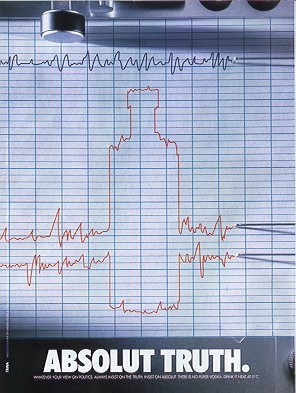
- For years Absolut Vodka has run a series of print ads with an image that suggests a bottle of the product with a caption including the brand name Absolut (suggesting the adjective absolute) followed by some noun it might modify, related in some way to the nature of the image
- Q2. Explain the imagery of the ad. Do you regard this as iconic or indexical of a bottle? Give one good reason for your answer (think about the images of Alfred Hitchcock in deciding how to respond).
Q3:
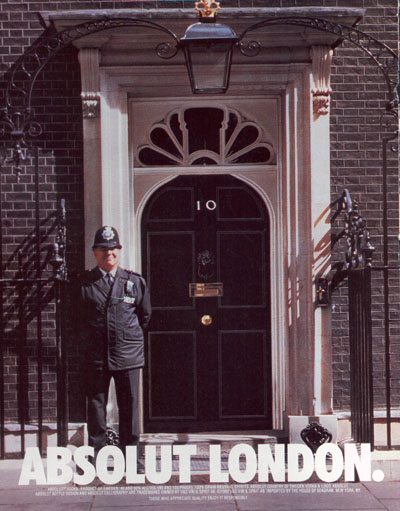
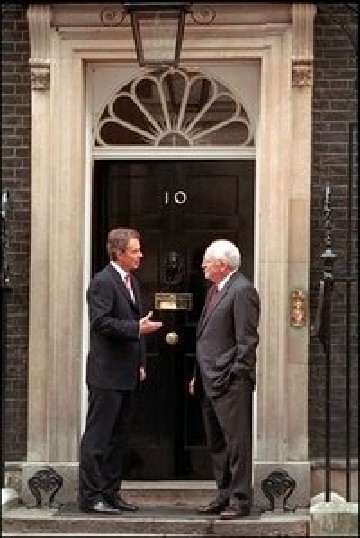
- Q3. Explain how this real image represents London. (If you don't recogize the location, use the filename on the second photo to google it and figure it out.) Identify the signifier and signified in the real photo. Then consider the ad, and identify the representamen, object, and interpretant of the image of the door in the ad.
Q4:
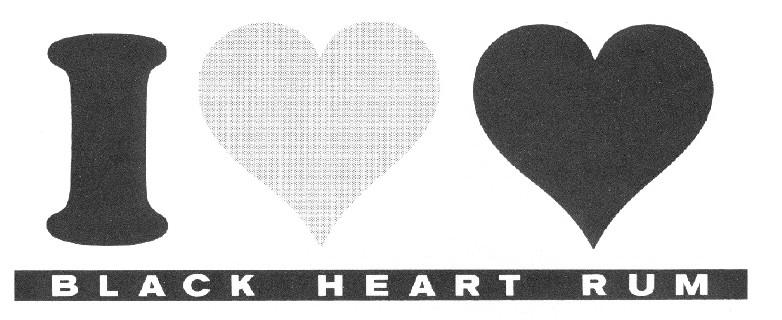
- Consider the ad linked here for a product named Black Heart Rum.
- Q4. Analyze the two heart-shaped signs in terms of Saussure and Peirce, defining signifier and signified for Saussure and representamen, object, and interpretant for Peirce. (Hint: Each of the heart-shaped signs in this ad has a different meaning, so you should address them both separately.) Which of the two competing models of the sign do you find better, or let's say more satisfactory, for analyzing a simple message like this one? Please give at least two reasons for your answer. (Another hint: There is no exclusively correct answer to this question that we are looking for, strictly speaking, but we want to see that you have given it some serious thought and have articulated a meaningful reason to yourself.)
Q5:
- The debate between radical realism and radical idealism may seem completely pointless to you.You see something, you perceive that it is real, so obviously it is in fact real.
- But in fact the nature of reality is a genuine and perplexing problem, and it extends even into the world of empirical exact sciences.
- Specialists in quantum physics struggle with real-world analogues to this problem as the bread and butter of their science.
- Here's a really interesting discussion of this problem on the layman's level by the physicist Brian Greene (author of The Elegant Universe) from the NPR arts program Fresh Air a few years ago.
- This relates to the current distinction between realism and idealism because if you cannot know where a particular particle is at any given time, only that it is in one of two equally likely places, then what does it mean to say that there is a firm basis to reality? It's a genuine conundrum.
- It also gives some theoretical basis for the notion of the "multiverse", which is so fashionable nowadays (for example, in the 2023 movie "The Flash" or the two recent animated Spider Man films). I'm not suggesting that these films present a scientifically defensible version of the idea, but they are at least referencing it.
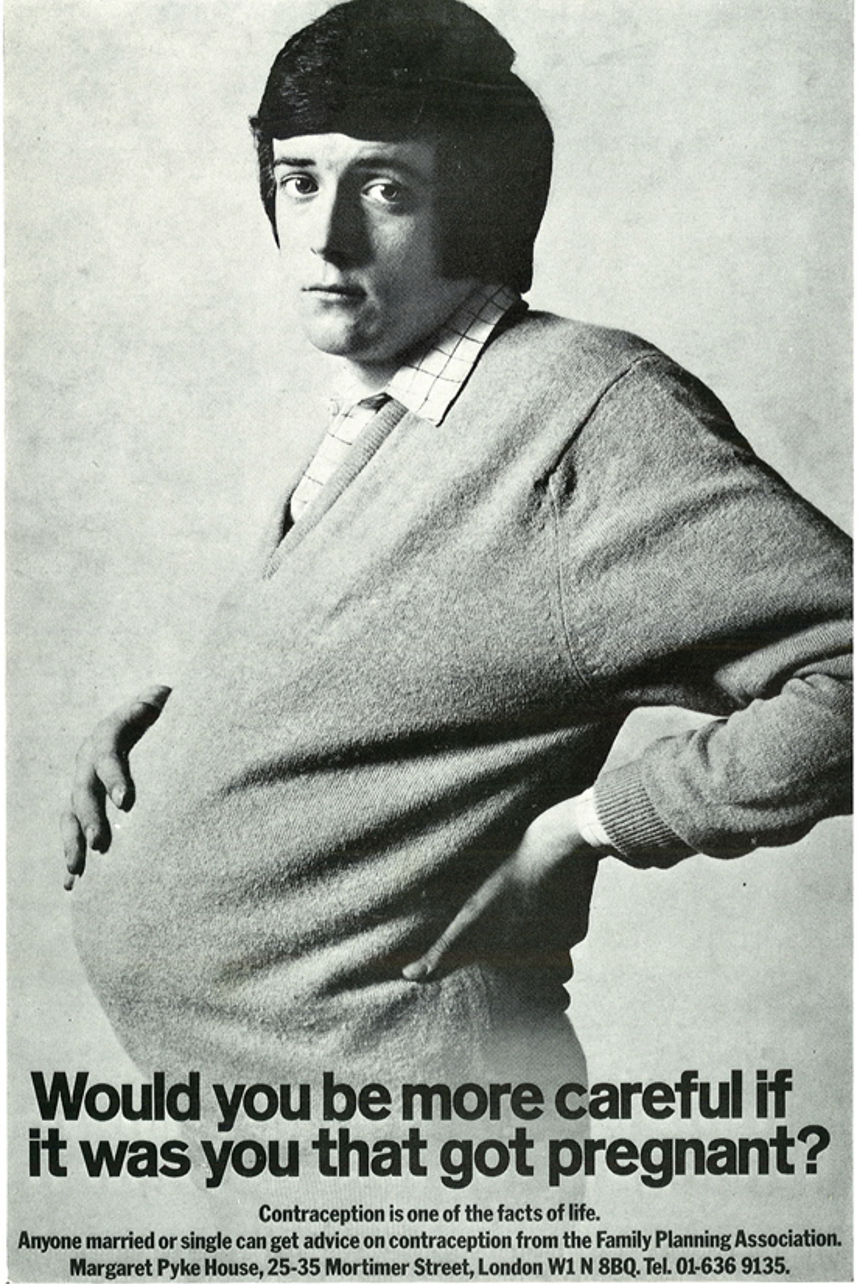
- Here is a famous provocative ad that appeared in the 1970s. It ran in Time Magazine, a news weekly, presumably in the British edition (given that the ad promotes a British organization).
- I realize that today it is now quite possible for a person identifying and presenting as male to become pregnant and give birth. Ignore that for Q1, as this ad appeared in the 1970s, in a quite different social and technological climate.
- As we've seen, ads can easily present a situation that defies reality. Sometimes it can be subtle and hardly noticeable, but sometimes it can be really flamboyant and outrageous in its defiance of reality.
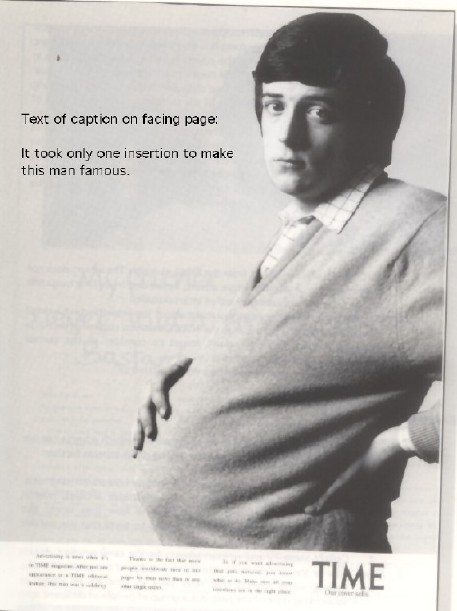
- Years later Time magazine ran an ad for itself based on this earlier ad. Here it is.
- This ad attempts to take advantage of the fact that many people were familiar with the original ad. The accompanying text on the facing page of a two-page spread has been typed into this copy of the ad. This was an ad exhorting businesses to advertise in Time, i.e., trumpeting how effective it is as an outlet for advertising.
- Q5. Explain what is happening in the original ad from the 1970s, paying attention to the intrinsic features of the ad (what's actually there). Be specific about what is real and what is "pseudo-real". In the later ad, how does the different purpose affect the degree of reality in the advertisement?