C103 - The Semiotics of Advertising
Week 6, Asynchronous Bundle 18
Written assignment due Friday 8/1 at 11:59 pm
Introduction
- Goal: Explore political advertising, both historical and for the most recent midterm election season
- Textbook: Chapter 4, 181-190
Asynchronous material
- Manipulation of the viewers' emotions is common in political advertising.
- Here's a clip from the TV show Mad Men, season 1, episode 10, where they show an old ad for John F. Kennedy running for president in 1960 and consider what's good about it compared with what Nixon is doing in his advertising. (Note: the characters are doing some ads for Nixon in this show, so Kennedy is the opposition.)
- Mad Men was a show that ran for about 7-8 years, devoted to Madison Avenue advertising creators and executives through the 1960s, and it went into the details of how some classic ads of that time were created.
- BTW, a PAC (political action committee) supporting the independent presidential candidate Robert Kennedy, Jr (son of the first Robert Kennedy--younger brother of John F Kennedy, attorney general in the Kennedy administration, and later US Senator from New York, who was assassinated just after winning the California Democratic presidential primary in 1968, which would have made him the likely Democratic candidate for President in that fall's election, again Richard Nixon) aired an ad during the 2024 Super Bowl which adapted this earlier 1960 ad for John Kennedy. It triggered a pretty hostile backlash for trying to hitch his independent (and trouble-making) candidacy to the much better reputations of his famous father an uncle). Ironically, the wealthy primary financial supporter of his PAC, Nicole Shanahan, was subsequently designated as Kennedy's vice presidential candidate... Trump has brought Kennedy into his government as Secretary of Health and Human Services.
- Here's that ad, and here's an article from the New York Times criticizing it (pdf version if you have trouble accessing the NY Times site directly).
- Here's a classic ad from 1964 that was instrumental in convincing
the vast majority of Americans that the deeply conservative Republican candidate for
president Barry Goldwater (running against Lyndon Johnson only a year after the assassination
of Kennedy) was a rabid war mongerer and would lead us into nuclear
conflagration with the Soviet Union
- Goldwater's slogan for this campaign was "In your heart you know he's right".
- The Democrats lampooned this with the (unofficial) counter-slogan "In your guts you know he's nuts"
- Q1. Pick one of the ads above, either the (real) Kennedy ad embedded in the Mad Men clip or the anti-Goldwater ad (which never actually ran on TV at that time) and discuss whether it feels fair or manipulative to you. I realize you didn't live in that era, and perhaps your parents didn't either. Explain the reasons behind your answer.
- Here is a seriously manipulative ad opposing Michael Dukakis, Democratic
candidate for President in 1988 (against George Bush Sr),
blaming him for a rape-murder committed by a convict named Willie Horton on a weekend furlough: Anti-Dukakis ad
- Note that Willie Horton is presented to look as threatening as possible here. This is not uncommon when African Americans are being presented as Bad Guys.
- This ad was unfair because Massachusetts instituted the weekend furlough program before Dukakis became governor, and Dukakis had nothing to do with Willie Horton being judged by the prison bureaucracy to be eligible for the furlough program.
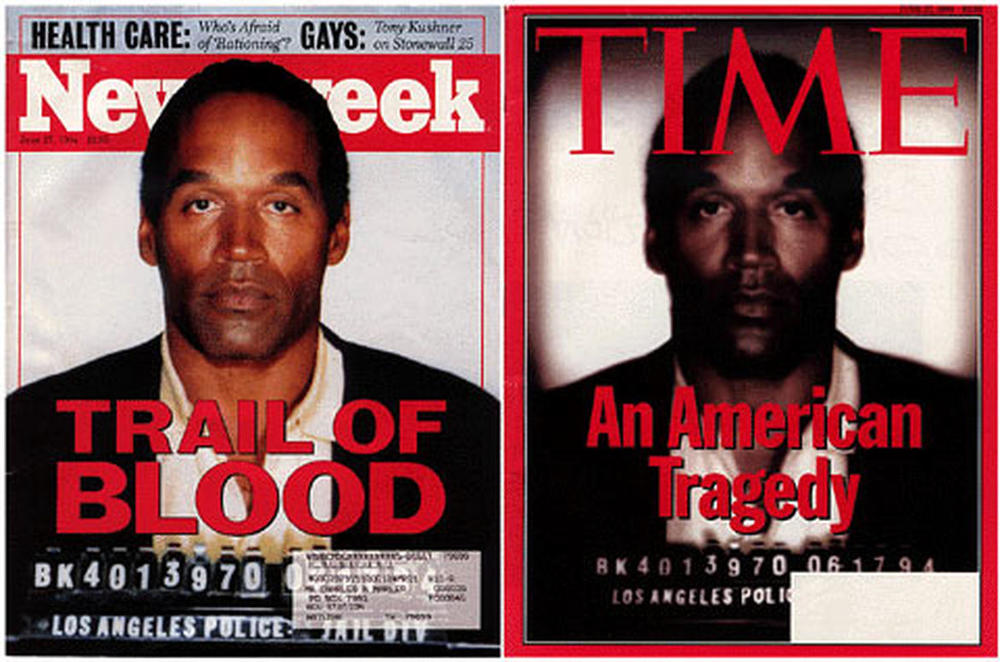
- Time magazine did something similar when it darkened O J Simpson's image during his murder trial (here are the Time and Newsweek covers side by side; the Newsweek cover is a more accurate reflection of Simpson's actual skin tone).
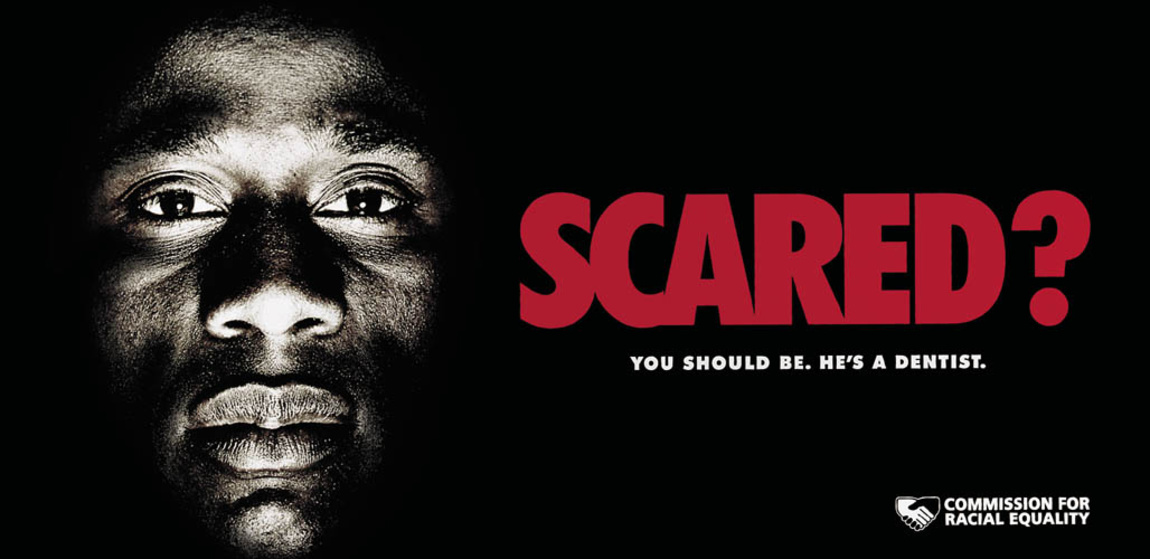
- Here's a billboard ad for the Commission for Racial Equality, which employs a self-reflexive joke based on the same idea: that dark-looking Black people are more threatening than lighter-skinned people.
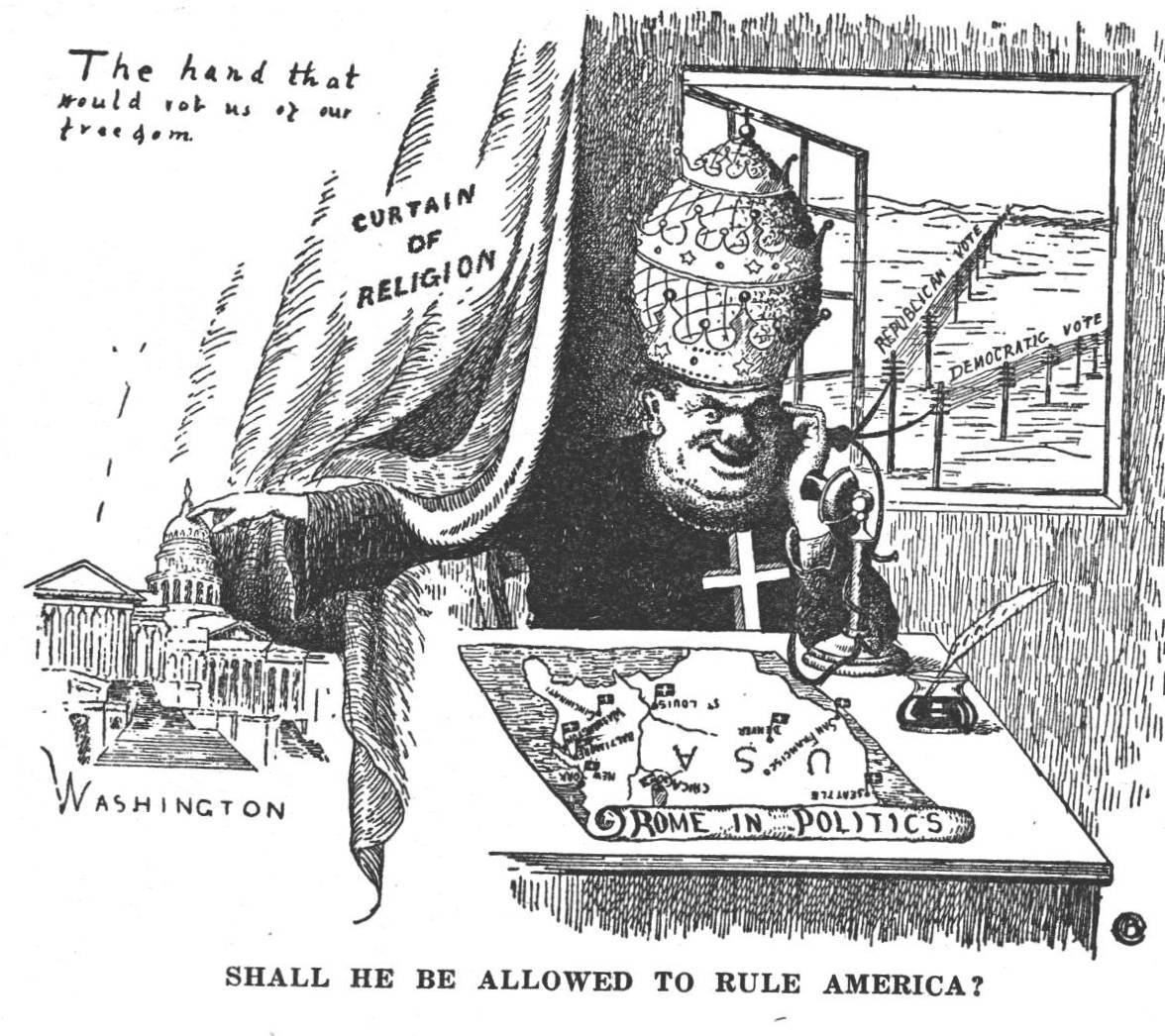
- Societal norms evolve, usually in a positive direction, and when you look back at earlier prejudices they can seem quaint and silly. Here's a 1943 anti-Catholic editorial cartoon which seems absurd today.
- Here's an ad from 2006, against a black Democrat named Harold
Ford who was running for the U.S. Senate from Tennessee (he was
previously a U.S. Representative). Despite leading in the polls
to begin with, he lost the election, in part because of ads like
this one, which in effect accuses him of inter-racial sex (along
with a host of other presuppositions).
- Note that this ad imposes unfair criticisms on the candidate in much the same way as the famous question "Have you quit beating your wife?". Such insinuations are very difficult to combat, making them a key ingredient in manipulative discourse. This device is called "presupposition".
- Q2. Pick either the anti-Dukakis ad or the anti-Harold Ford ad and discuss whether or not it is explicitly racist, and explain why.
- In 2008, before the Supreme Court came down on the side of marriage equality, support for same-sex marriage still had only minority support in the country. In California there was a ballot initiative called Proposition 8 which defined marriage as between a man and a woman. It inspired some highly manipulative advertising
- Consider these two ads: Yes (confusingly, "Yes" meant voting against marriage equality) and No (in favor of marriage equality). ("No" is inspired by the great series of Apple Computer ads known as "I'm a Mac, I'm a PC"; here's a funny sample if you don't know them; and while I'm at it, here's a youtube compilation with 66 of them, reportedly all that were made)
- Q3. These two ads were on the opposite side of a very intense debate over Proposition 8, and they are forceful and effective. Explain what is fair and what is unfair in each ad. Which is "fairer" on the whole? Why do you think so?
- Donald Trump's campaign ran some truly vicious ads in 2016 against Hilary Clinton. Here's one in which her health is not mentioned in the text of the ad, which criticizes her (that is not in and of itself unfair, but the string of video clips showing her stumbling and so forth carries the real message). The 2024 presidential campaign featured some seriously unfair advertising, but I'm not going to get into that this summer. Maybe next year.
- In 2020 the national election was highly polarizing, and you can no doubt imagine we had some pretty aggressive and manipulative TV and Internet ads.
- Trump ran some ads in 2020 which simply presented false information. That's not exactly manipulation in the sense I've been using it, that's just false advertising.
- For example, Trump would frequently advertise that his economy was the greatest in US history (sometimes, in post-World War II history). That wasn't true by any measure, but making that claim was in no way manipulative, it was simply an exaggeration. That's pretty typical in political advertising.
- You probably don't remember this, of course, but former vice-president Al Gore, the Democratic candidate who lost to George W Bush in 2000, seriously exaggerated his role in developing the internet. This didn't work to his advantage, as people took it as untrue and made fun of him over and over as a result (you can see this in the Saturday Night Live sketches from the fall of 2000).
- The Trump campaign aired at least one ad that used doctored photos to suggest that Biden was cognitively impaired. I don't have that ad itself, but I can link to this short CNN report on the ad, with two of the pictures shown.
- By now you guys must know that I am a fairly liberal Democrat, and a Never-Trumper. However, it is not the case that the Democrats had clean hands here.
- Here's an example where the Democrats reply to one of Trump's frequent claims from 2016: "I alone can fix it".
- This feels unfair and manipulative to me because, first, that phrase had a specific reference in 2016 (he was talking about being able to clean up corruption in Washington, DC because he was a true outsider), whereas they were grafting that sentiment onto the coronavirus crisis, where he didn't actually make that claim; and second, because it is unfair to blame the US problems with our handling of the coronavirus on Trump alone. Sure, he did poorly, but it was a widespread failure, whereas the ad implies strongly that it was his failure alone.
- An interesting wildcard in the 2020 election was a group called The Lincoln Project. This was a group of very well-funded never-Trump Republicans who opposed his reelection. They ran some pretty compelling ads. Here's one from their "Mourning in America" series.
- The title phrase, repeated several times in the ad, is a great adaptation of a slogan that Republican hero Ronald Reagan used in his 1984 reelection campaign: "Morning in America".
- I was never a Reagan admirer, but his 1984 ad is a really effective example of political persuasion, and not illegitimate manipulation, in my view. It is masterfully produced, and is based on presenting positive accomplishments by the Reagan administration in the early 1980s, coming off the somewhat failed Carter administration. Some of the claims may be exaggerated, but, again, that's not manipulation in and of itself, and is standard fare for political advertising. Even I can admit that Reagan had some real successes in his first term (especially wringing chronic inflation out of the economy).
- Here are some more 2020 ads that I generally consider manipulative (and effectively so). Unfair though.
- First, two ads for Biden:
- "Go from There" (played during the World Series)
- "Trump Playing Golf" (This is a report on the ad. Ignore the report and watch only the ad which runs for about 30 seconds starting at 0:51)
- Now, two Trump ads
- Q4-5. Pick one pro-Trump ad and one anti-Trump ad from the material presented above and explain whether or not each is manipulative/unfair in your opinion. If you argue that it is, cite several ways in which it manipulates the viewer's reactions. If you argue that it is not unfair, give several reasons for your answer. Please note that politics plays no role in my evaluation of your answer to this question. You can be a hard-core Trump/MAGA supporter (like the instructor's wife) and still earn full credit for your answer to this or any homework assignment in this course.
- The 2022 campaign didn't produce a lot of memorable ads (that I learned about, at least). This despite the fact that over $10 billion was spent on advertising by both parties. Nevertheless, I will show you one fair and responsible political ad from that mid-term election year, in my view.
- Here's a solid, encouraging, positive, somewhat bland ad for Ohio Democratic Senate candidate Tim Ryan. He actually lost to JD Vance (now our new vice-president!), perhaps due to the fact that he didn't produce a lot of vicious attack ads. Or possibly just because Vance caught the prevailing winds in the state of Ohio in that campaign.
- I have seen a lot of unfair and manipulative ads from 2022, but I won't give any more of them to you today. None of them is particularly memorable, and I think we already have enough manipulation here!
Why is advertising interesting to study?
- Well, because there's a lot going on in ads because
- they are short texts
- the makers are intensely interested in achieving successful communication
- and there's lots of money in advertising, so the makers tend to be well
motivated
- there has evolved a kind of pride among ad makers in producing aesthetically
compelling ads
- Let's consider some interesting ads, for various reasons
- Sometimes an ad is not intrinsically interesting, but becomes interesting because of its social or political context
Why is semiotics interesting or useful?
- What is semiotics?
- At the simplest level, it is the scientific study of signs
- Now we have to ask, what is the sign?
- The sign can be defined as any elemental signal of communication
- may be linguistic (words written or spoken)
- may be visual, either abstract of concrete
- may be direct or indirect in its relation to its message
- Any communication requires a minimum of two parties in order to
take place
- A speaker (or other source), who provides a message
- A listener (or other recipient), who receives and interprets
the message
- Does a sign communicate in the forest if there is nobody watching
it? (like the proverbial tree falling in the forest)
- Consider the phallic symbol
- Semiotics gives us some tools for analyzing the content and presentation
of any text that communicates a message.
- A text is any collection of signs that conveys a message.
- It is a particularly good methodology, or framework, for analyzing advertisements,
where there is a lot being communicated in a small package.
- It combines interpretation of the intentions of the creator of the text
with an appreciation of how the viewer perceives the text
- It enables us to analyze the text in terms of its intrinsic features
and juxtapose it to the social and cultural background against
which it functions