C103 - The Semiotics of Advertising
Week 6, Asynchronous Bundle 17
Written assignment due Friday 8/1 at 11:59 pm
Introduction
- Goal: Explore something of the history of LGBTQ-associated advertisements and their growing acceptance over the past couple of decades.
- Textbook: Chapter 4, 181-190
Asynchronous material
- Uses of LGBTQ imagery and themes in advertising
- During the period I've been teaching this course on and off (since the late 1990s) societal attitudes toward LGBTQ individuals have changed quite a lot, moving from majority disapproval to majority acceptance (or at least lack of concern).
- One could argue that a proper viewpoint would be, "who cares anyway?" rather than either homophobia or gay pride.
- We can think of the code reflecting attitudes toward LGBTQ imagery as a scalar continuum running from full disapproval to full acceptance.
- It is obvious that an ad made from the position of full acceptance isn't going to be effective if the audience is comprised of people whose code amounts to full disapproval. And the reverse as well.
- So we might expect fewer ads portraying gay characters sympathetically on Fox News, for example, than on something like MSNBC.
- There are plenty of ads which express a roughly disapproving attitude toward gay themes illustrated in the ad
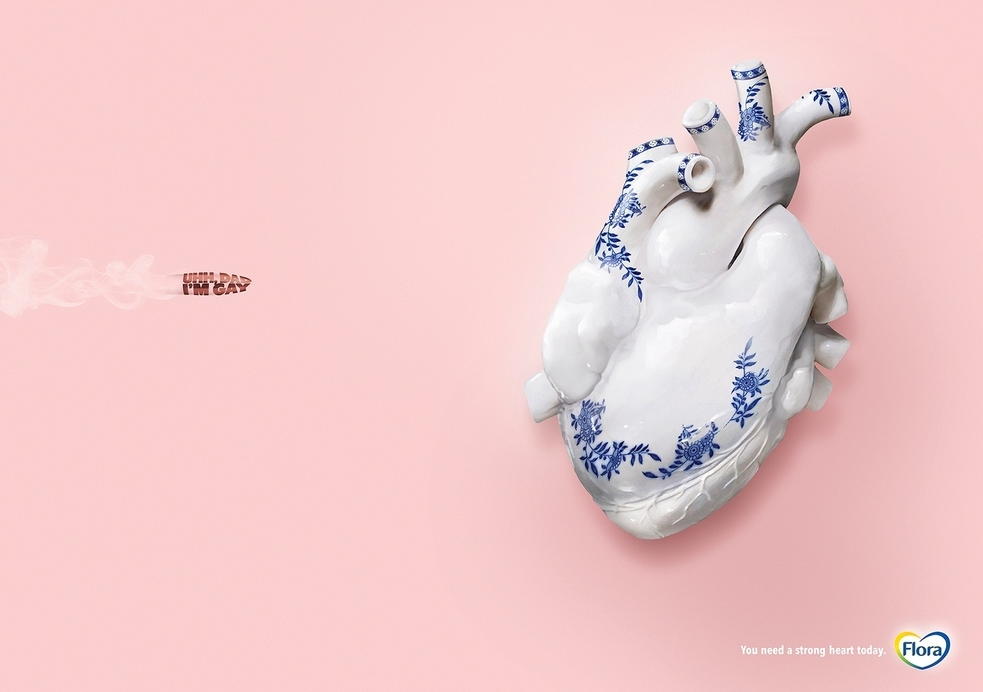
- Here's a recent example that was withdrawn due to the negative response it evoked (a butter substitute called Flora)
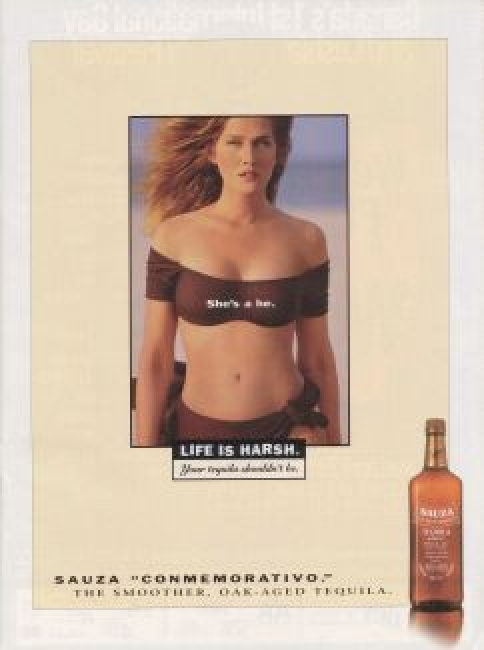
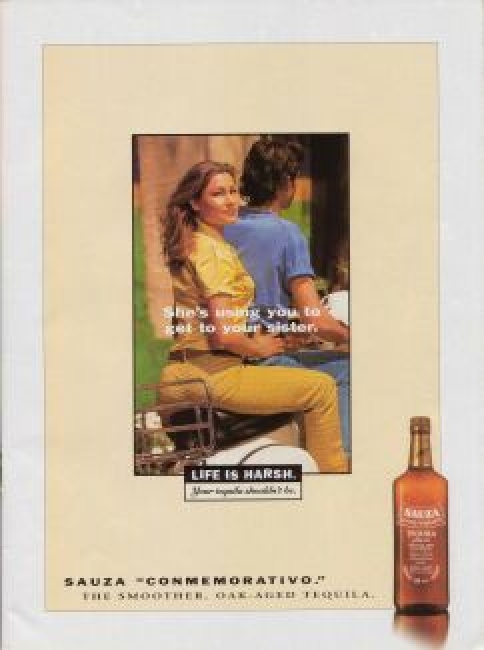
- Or here's a Tequila ad suggesting that a trans woman shouldn't be attractive to a man (and another in the same campaign)
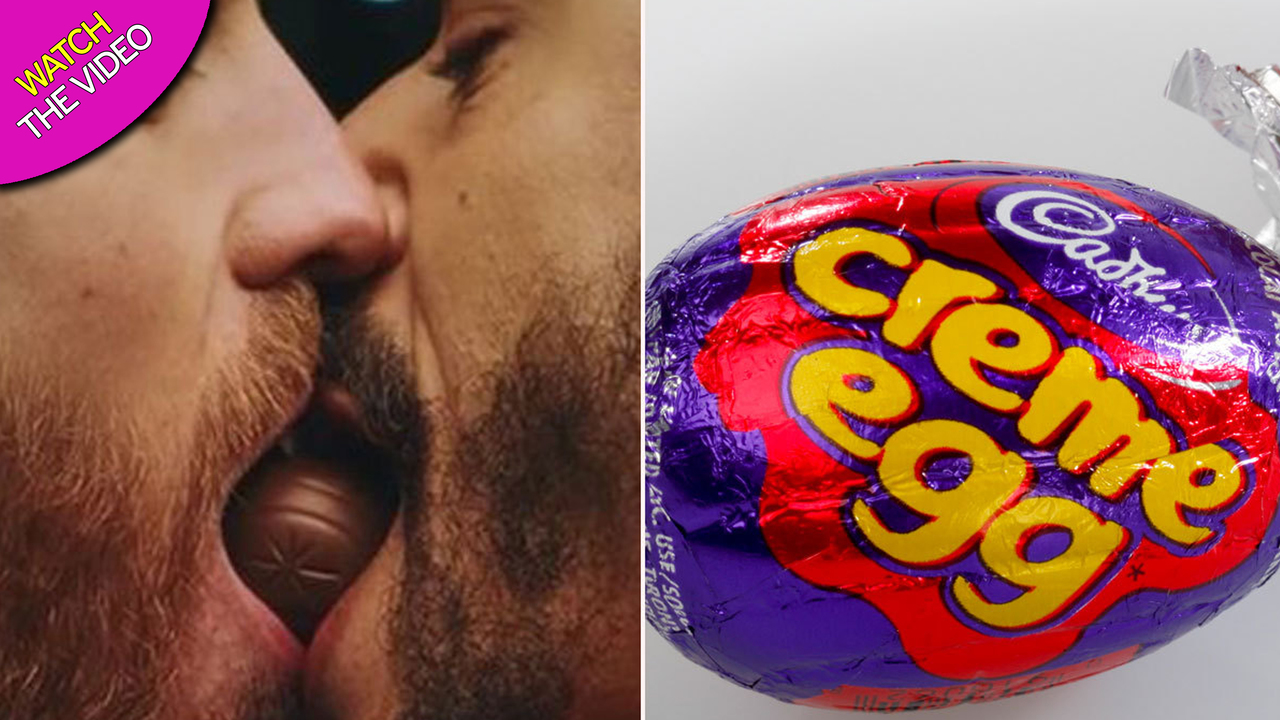
- In some cases, we can find gay imagery intended seriously and approvingly, but which provoked serious negative blowback
- This Cadbury chocolate egg ad (one of a series) would certainly fit that description
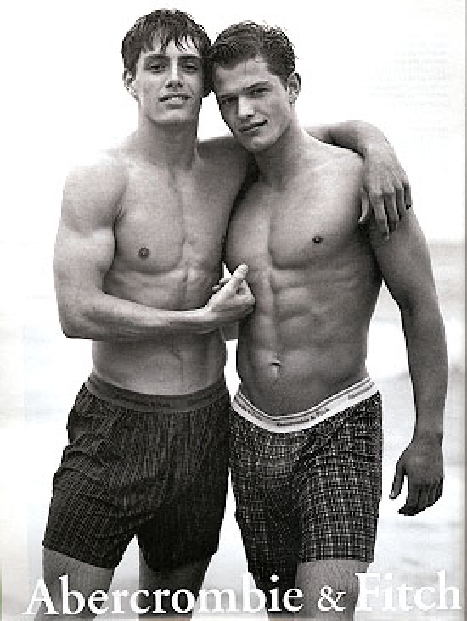
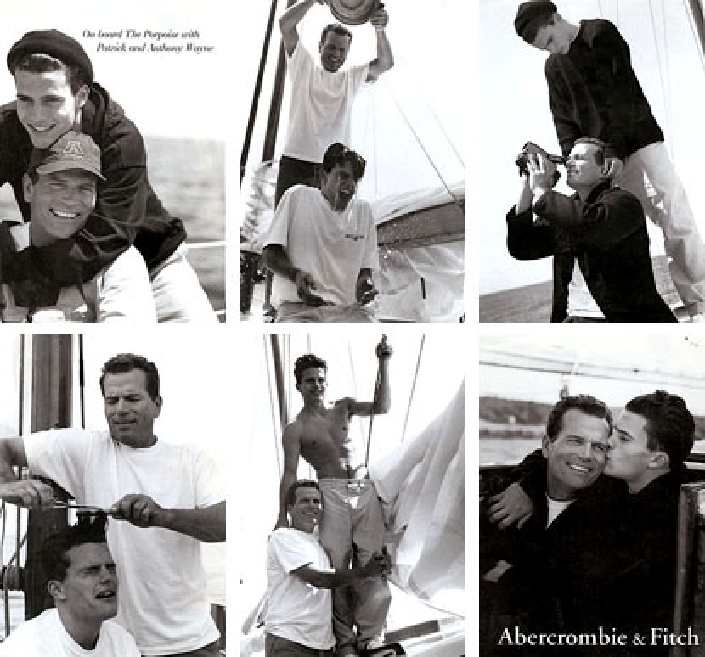
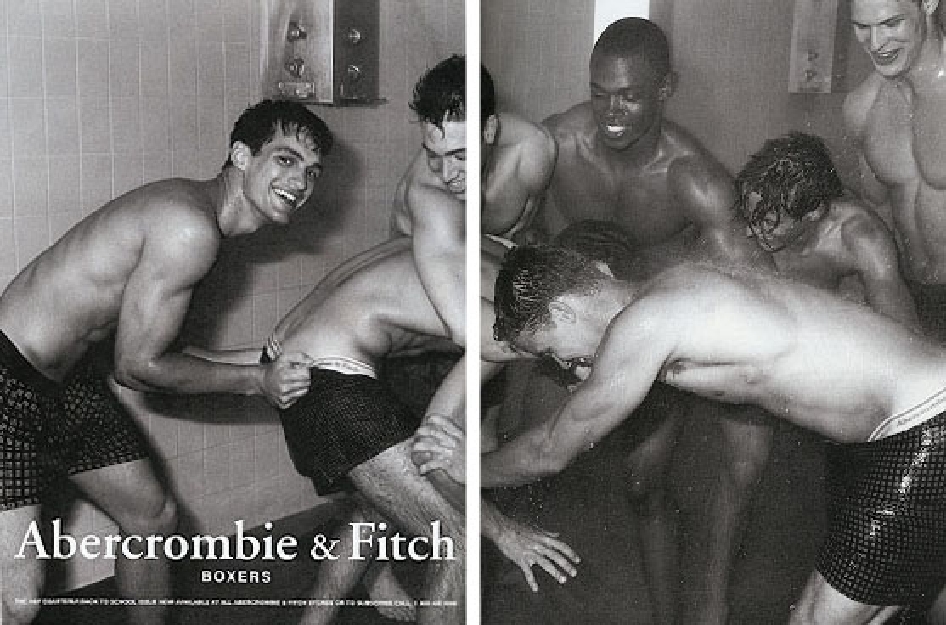
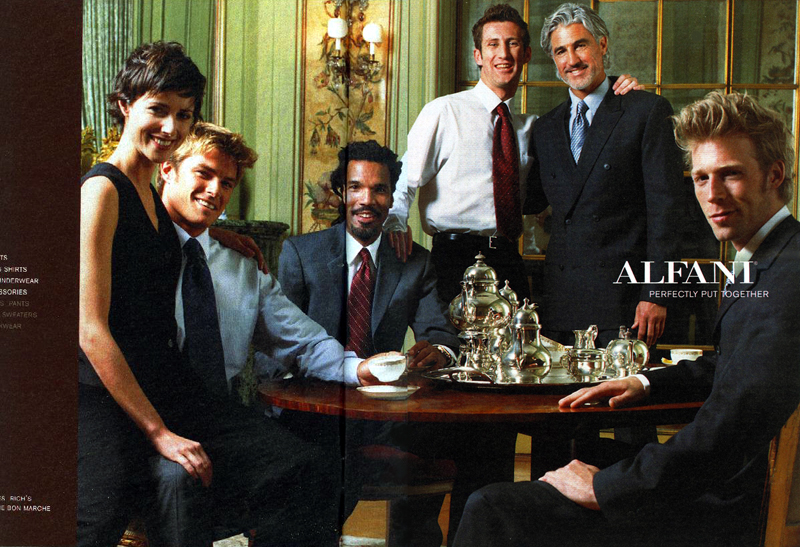
- In the early years of this evolution (say late 1990s to early 00s) there was a lot of "gay vague" imagery, especially in fashion advertising
- I define "gay vague" as imagery that is not explicitly gay in its content but permits the interpretation that some of the people in the ad are likely to be gay
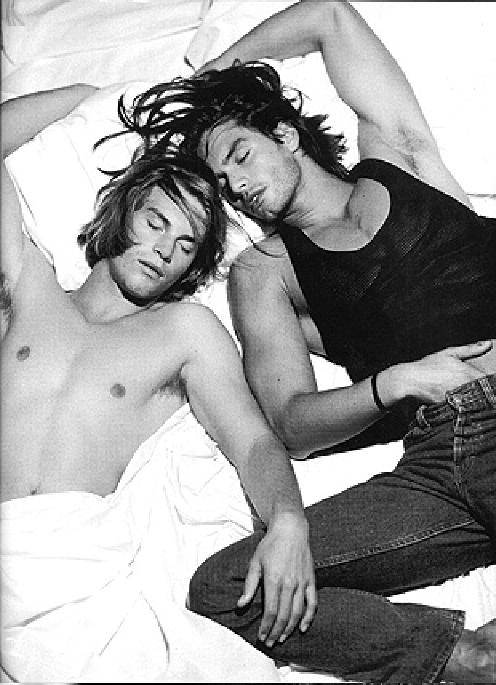
- Abercrombie
& Fitch boxer shorts (2nd
ad, 3rd
ad)
- Digression: there is a funny story asociated with the second of these ads. The two men shown are presented as if they could be a younger man and his older lover. In reality they are father and son. And what is more, the models are the son and grandson of Charlton Heston (an actor known from the original "Planet of the Apes" as well as the original "Ben Hur"). At the time this ad was put out, he was president of the National Rifle Association and a very strong conservative, with explicitly homophobic views. So they were making fun of him by using his son and grandson as models for this ad.
- Alfani (fashion
ad)
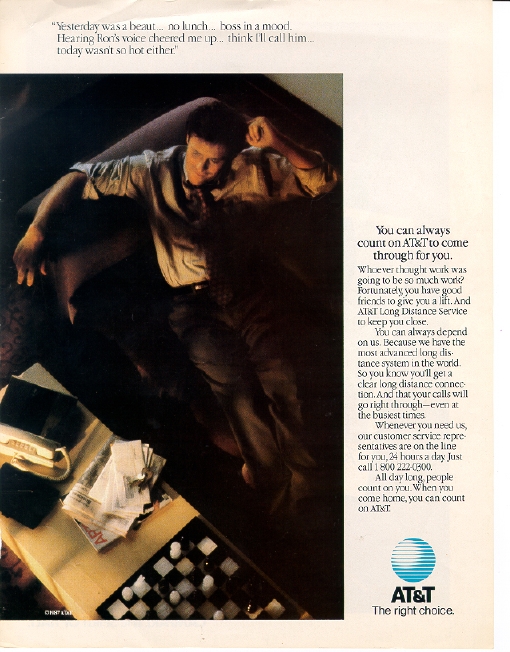
- AT&T
- Calvin Klein 1995 (big series of gay vague ads): typical print ad
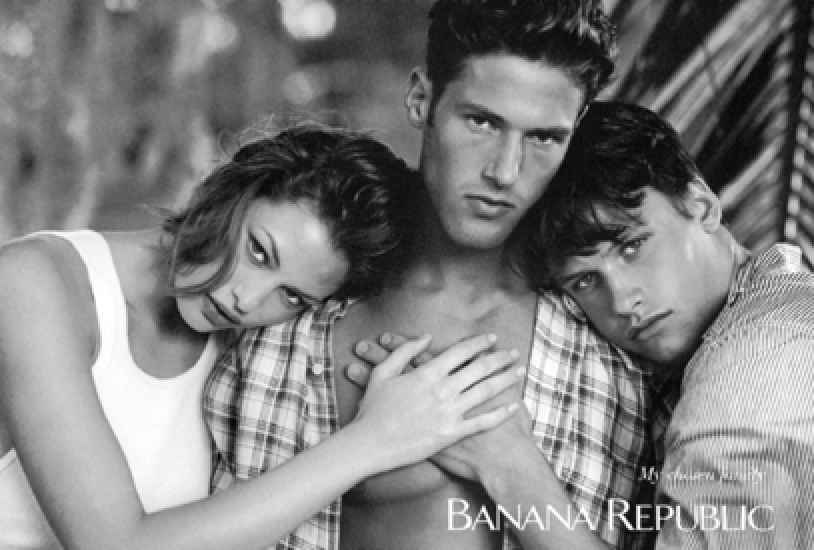
- Some of these also suggest themes of bisexuality: Banana Republic (and another
one)
- Q1. Taking these last "gay vague" ads as a group (from Abercrombie & Fitch through Banana Republic), what about them suggests that some of the people shown might or could be gay? (Be specific about details, bearing in mind that even a small detail in a text like this can be semiotically meaningful.) In an environment where the majority of Americans disapproved of the "gay lifestyle", what do ads like this suggest about our society?
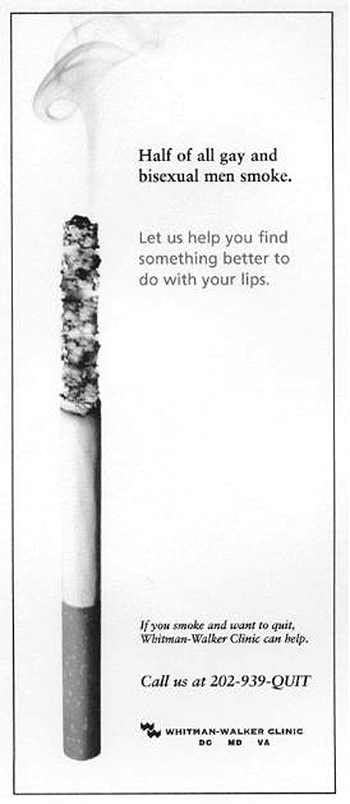
- Some ads were aimed at a strictly gay audience and distributed in appropriate outlets (like magazines that were marketed to gay readers)
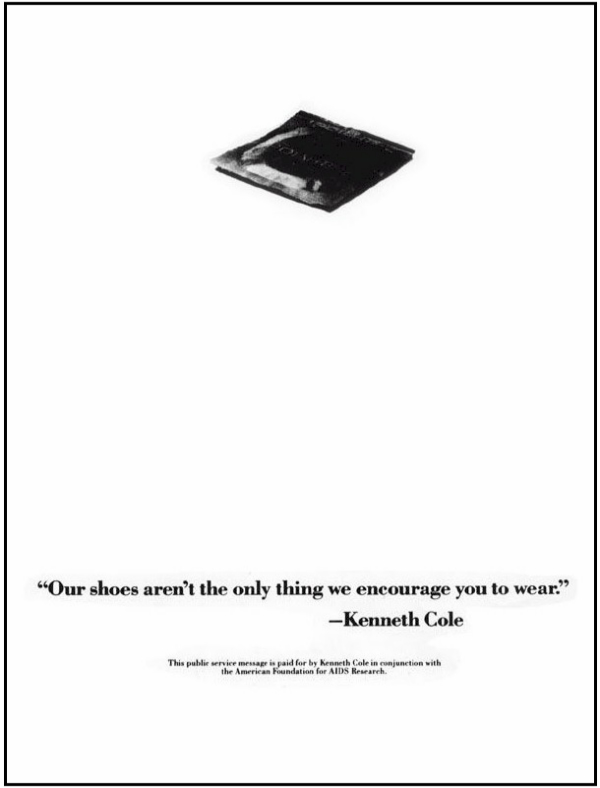
- Some of these were HIV awareness ads aimed primarily at gay men (here's a 1987 example), although a lot of campaigns were also directed at destigmatizing HIV among the general public, and these were not limited in their audience outreach.
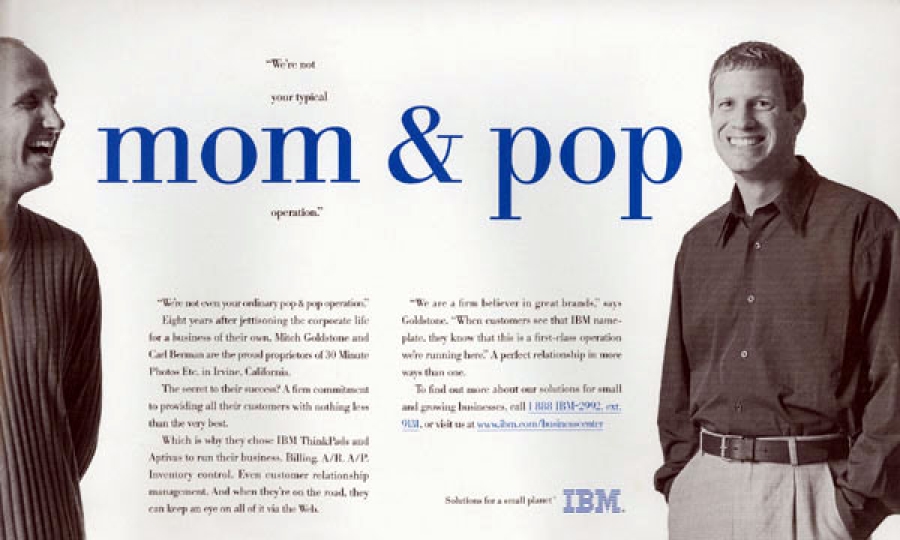
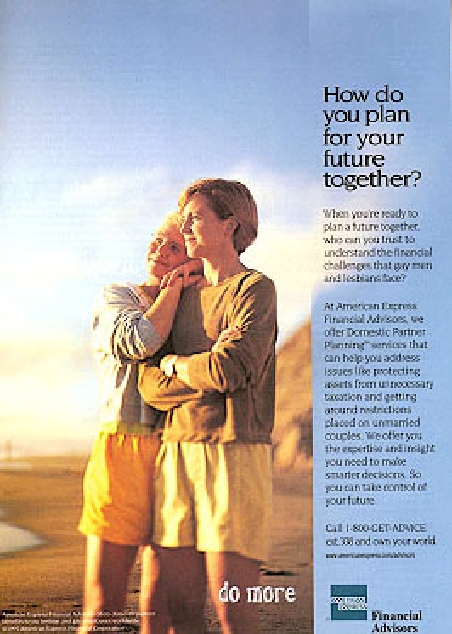
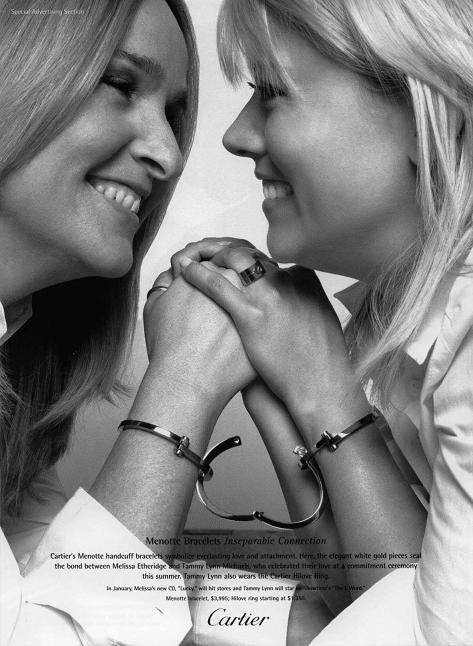
- But there were also some which served broader themes but just happened to pitch them to gay readers (treating them as just another niche audience, like soccer fans or Mercedes drivers)
- At the same time, there were some ads which were reflexive and indicated a degree of ambiguity about the majority reluctance to accept gay people.
- This Heineken ad is very self-aware in this respect
- Q2. Do you regard this Heineken ad as pro-gay, negative on gay orientation, or neutral? Why?
- As time moved on and societal attitudes changed, some major corporations began to make completely matter-of-fact, non-judgmental ads with obviously gay themes.
- Some of the
more prominent efforts in this direction were quite tentative and permitted some degree of ambiguity in the interpretation
- Case in point: this 1997 Super Bowl ad for John
Hancock financial services. You may need to watch this several times to pick up on all the nuances
- This is the original version of the ad, and it attracted some protests from the general public. Two things changed before the ad was used again on television: 1) they took out the shot of the baby; and 2) they eliminated the whispered line "So are you" from the soundtrack at the very end of the ad, as it goes to the John Hancock logo.
- Q3. Think about this ad in the context of including gay themes in mainstream advertising back around just before the time most of you were born (!). What would have made the ad controversial at that time? (I'm looking for one main point here.) And how do the changes made to the original ad address that degree of controversy? (Consider both modifications in responding to the second question.)
- Today we are at a point where many high-value companies, completely mainstream, believe that there is little to no consumer resistance to gay-themed ads. In short, they are voting with their pocketbooks.
- Of course, it is not the case that this is a inevitably smooth road to travel. As an example, consider the recent backlash against Bud Light beer, which arranged for a trans influencer to do a Bud Light endorsement, resulting in a boycott that is continuing today and has cost the company millions of dollars.
- Here's a New York Times article that summarizes the story behind the recent Bud Light controversy. If you have trouble accessing the NY Times, here's a pdf of the article. The actual article on the NY Times site is better because not all the graphics and links made it into the pdf snapshot of the page. (BTW, as an IU student, you have the right to a free account to read the NY Times online via a contract they have with IU. For information about this, you can go here.)
- The earliest unambiguous full-acceptance ads were often from the most liberal companies, like IKEA
- IKEA ad about committing to a dining room table (very up-front and matter-of-fact about their life together)
- IKEA transgender surgery ad. (Thought question: what is the most telling info about this being a transgender surgical patient?)
- Sometimes these ads seem to be just too damned proud of their themes, like this Bjorn Borg ad (a fashion company)
- My problem with this ad is that it seems to want to be maximally provocative, and then it wants you to admire the company for how brave and liberal it is, and to note the the utter acceptance displayed by every single person attending this wedding, rather than just integrating the gay consumers or models into the full range of humanity. True liberal acceptance wouldn't have to draw such attention to itself! And the coy presentation of the priest (one of the men wearing a clerical collar is taller than the other, so we only see one of the tell-tale collars until very near the end, leading us to imagine that he is performing a ceremony between a man and a woman) is something I also react to as bogus. Grrrrr!
- McDonalds is another company with such broad mainstream acceptance that it feels sure enough of itself to integrate gay characters into its ads without making such a big thing out of it. Here's a French McDonalds ad which is highly aware (reflexive) of its handling of the issue, but smooth and unobtrusive at the same time. Watch it several times to pick up on all the nuances!
- Q4. Summarize what is going on in the story this McDonalds ad tells (I don't mean that you should break it down according to the narrative typology we presented earlier!), and state what you think the advertisers' attitude is toward the boy and his sexual orientation.
- For purposes of thought and analysis, the best kind of ad to consider is one which sends mixed signals. Here is a splendid ad shot by Guinness sometime in the mid-00s but never actually aired on TV.
- When I call it "splendid", I mean in aesthetic and rhetorical terms. I don't necessarily mean that it would do a great job of selling the product. To be fair, though, Guinness makes lots of ads that are very interesting but not necessarily direct in their attempt to promote the product for its qualities as a beverage. Here's a wonderful example by my all-time favorite admaker Frank Budgen. You don't need this for the homework, but do watch it if you are interested in great ads.
- Q5. Construct two brief arguments, supporting each point of view with specific details from the first Guinness ad above: one argument that this ad is very supportive of the two gay men in their relationship as portrayed in the ad; and one argument that this ad does not ultimately believe in their life, and wants to undercut it subtly. You don't have to believe in both sides of this argument, but I'd like you to try to make both sides of it. (Like lawyers, who have to be willing to argue for things they don't personally agree with.)