C103 - The Semiotics of Advertising
Week 5 Lecture Notes
Monday 7/21/2025
Zoom link for each Monday's real-time online lecture.
Link to watch the recording of today's lecture (available after the lecture has taken place).
For next Monday's lecture
- Please read Chandler, Chapter 4 "Codes", 149-94.
For the rest of this week
- We have three bundles of asynchronous work and assignments for the week.
- The due date for the three assignments is Friday 7/25, 11:59 pm.
- Bundle 13 Exploration of intertextuality in advertising
- Bundle 14 Extensive look at intertextuality based on the great Russian silent movie Battleship Potemkin (not using advertisements).
- Bundle 15 Further exploration of intertextuality in advertising
- Reminder: term paper proposals are due by Wednesday night 7/23. For information about the term paper and the required 20-point advance proposal, go here. As of today, when I was in the gradebook, one had been submitted. I need a proposal from everybody by Wednesday, and I hope to get them all approved by Friday at the latest. That way you'll have certainty on proceeding ahead with the term paper, if you are the type to get started early on it!
- I have to say, guys, that you have done a really excellent job on the 7 bundles I have completely graded so far. (Yeah, I'm still behind, but I'm trying to catch up!) My main opportunity to take points off is when you mess up and don't answer the whole question or all the subparts. It's true that there is no intrinsic advantage to me in taking points off. It's not like I can take them away from you and use them to buy beer or something!
Intertextuality (Chapter 6 of Chandler, 225-62: Interactions)
- Two alternative approaches to a text:
- Structuralist
- Every sign in a text has meaning based on its paradigmatic qualities
and its syntagmatic relations with other signs in the same text
- --> Analyze the internal features of the text
- Intertextual
- The text doesn't exist in a vacuum: our interpretation of it is
colored by our knowledge of other semiotic texts.
- --> Analyze the text in terms of its external relations to other
texts
- Intertextual relations may have several types of function in a particular
text
- The target text picks up associations and connotations derived
from the source, and applies them to the same purpose straightforwardly. The makers of the secondary text can basically import knowledge and emotions that the reader/viewer has from previous acquaintance with the source text. It can be an efficient way to jump-start the impact of a text, such as an ad.
- This can also be done seriously, for example, a poem may refer
to another poem. This is too dull to exemplify when done seriously,
but here's a humorous ad line for Martha Stewart's product lines:
- Oh, Martha Stewart, how do I love thee? Let me count the ways. (This was originally found on Martha Stewart's own website www.marthastewart.com, but the page with these lines is no longer there, alas.)
- Original poem
- The target text points to associations from the source, but turns
them on their head (often for satirical purpose)
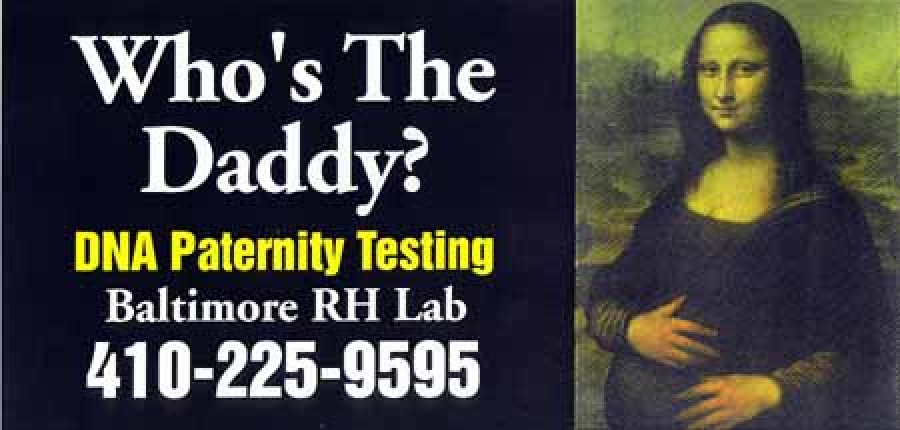
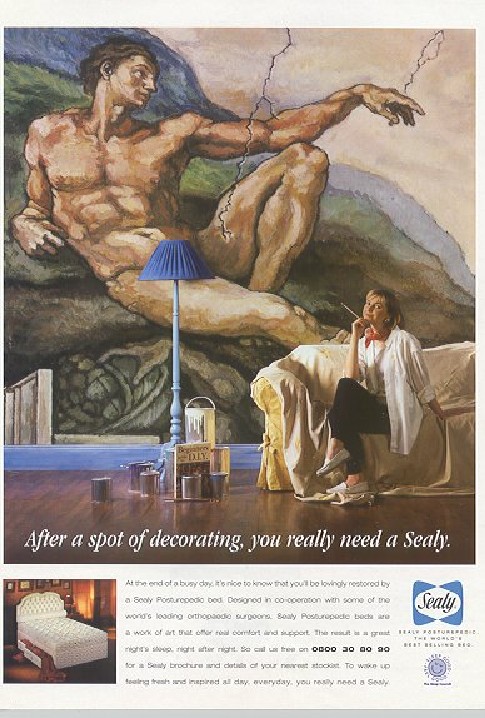
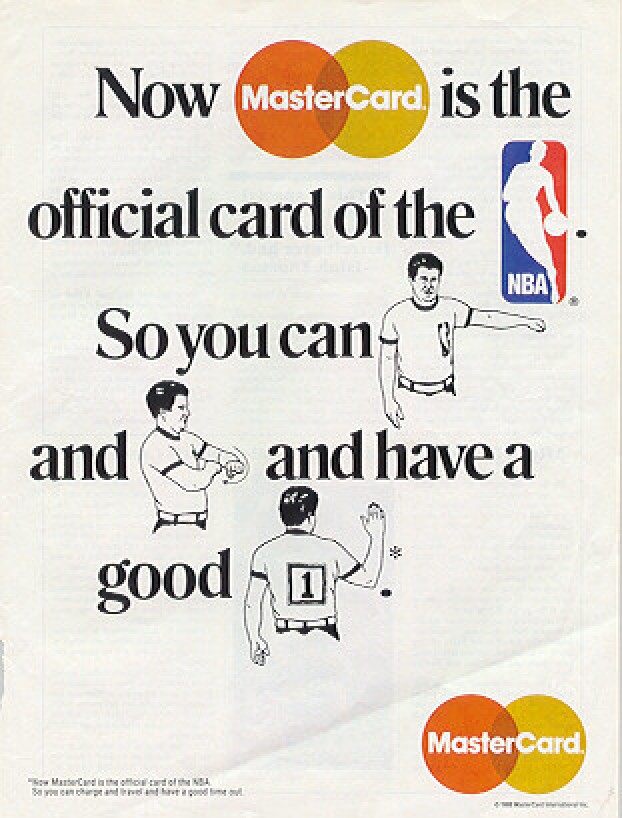
- Advertising exploits intertextuality all the time, in all these ways.
- A key question is always going to be: how does this ad function if
the consumer doesn't recognize the source of the intertextual reference?
- What can advertising interact with?
- High culture (literature, art, music, etc.)
- Literature
- Classical music
- Art (etc.)
- Any text whatsoever (in the semiotic sense of any message
which communicates meaning)
- Popular culture
Features of intertextuality
- Chandler identifies the following "defining features" of intertextuality
- reflexivity: how reflexive (or self-conscious) the
use of intertextuality seems to be (if reflexivity is important to
what it means to be intertextual, then presumably an indistinguishable
copy goes beyond being intertextual);
- alteration: the alteration of sources (more noticeable alteration
presumably making it more reflexively intertextual);
- explicitness: the specificity and explicitness of reference(s)
to other text(s) (e.g. direct quotation, attributed quotation) (is assuming recognition
more reflexively intertextual?);
- criticality to comprehension: how important it would be for
the reader to recognize the intertextuality involved;
- scale of adoption: the overall scale of allusion/incorporation
within the text; and
- structural unboundedness: to what extent the text is presented
(or understood) as part of or tied to a larger structure (e.g. as part
of a genre, of a series, of a serial, of a magazine, of an exhibition
etc.) - factors which are often not under the control of the author of
the text.
- Reflexivity is an especially interesting question
Intertextuality in "The Grinch" (book, cartoon, movie)
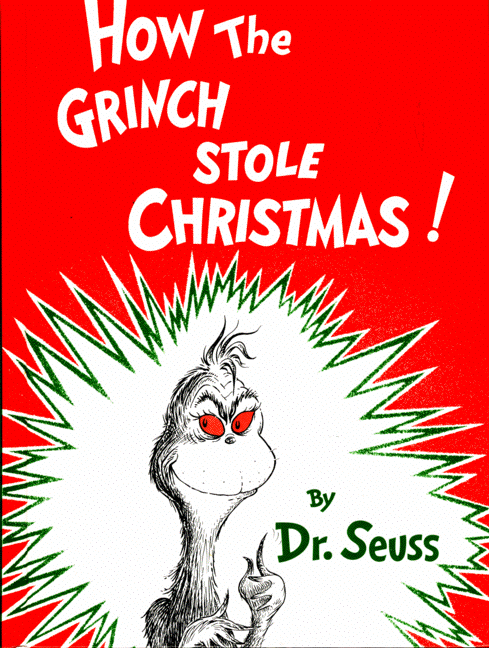
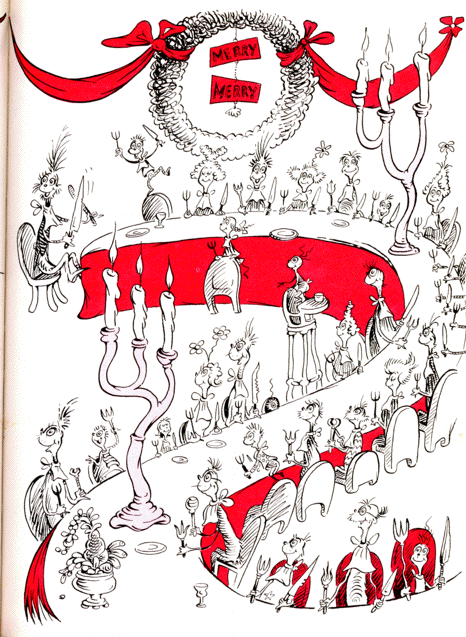
- "How the Grinch Stole Christmas", by Dr. Seuss
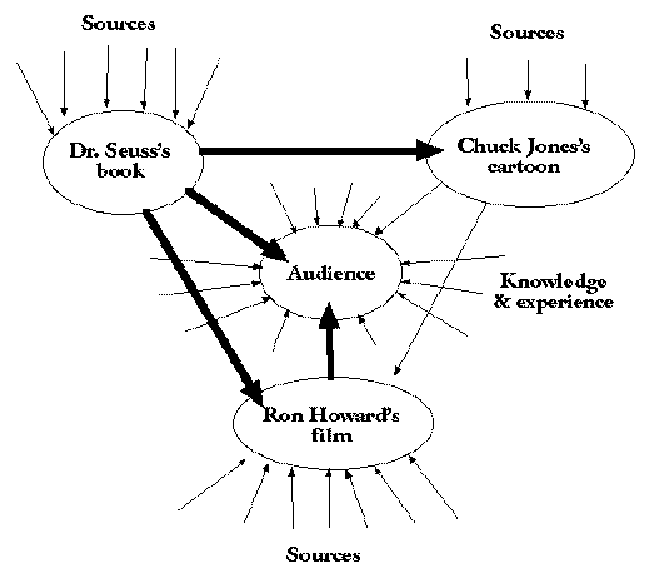
- Network of intertextual relations
- Sources
- Main source for text of book: "The Night before
Christmas" (as well as what we discuss about the movie)
- For cartoon, main source is book, but there are some auxiliary sources
based on Chuck Jones's experience
- For movie, three main sources:
- book
- cartoon
- more robust apparatus pertaining to sources of book
- How does a feature film differ from a book or a 26-minute cartoon?
- Set design/production design
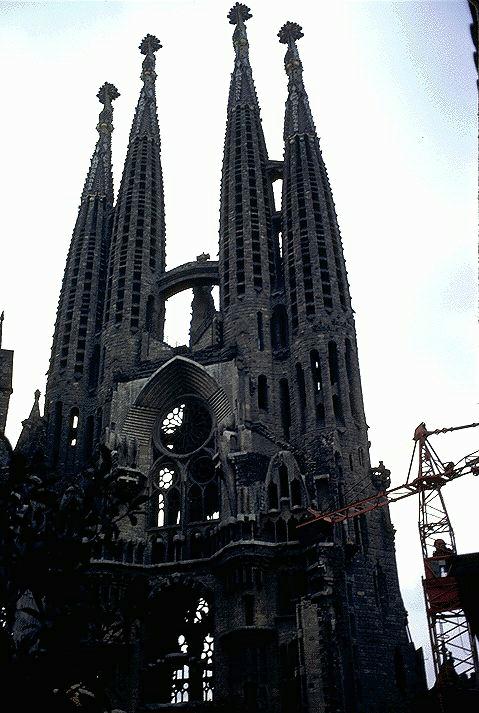
- Architecture!
- Antonio Gaudi (Catalan architect)
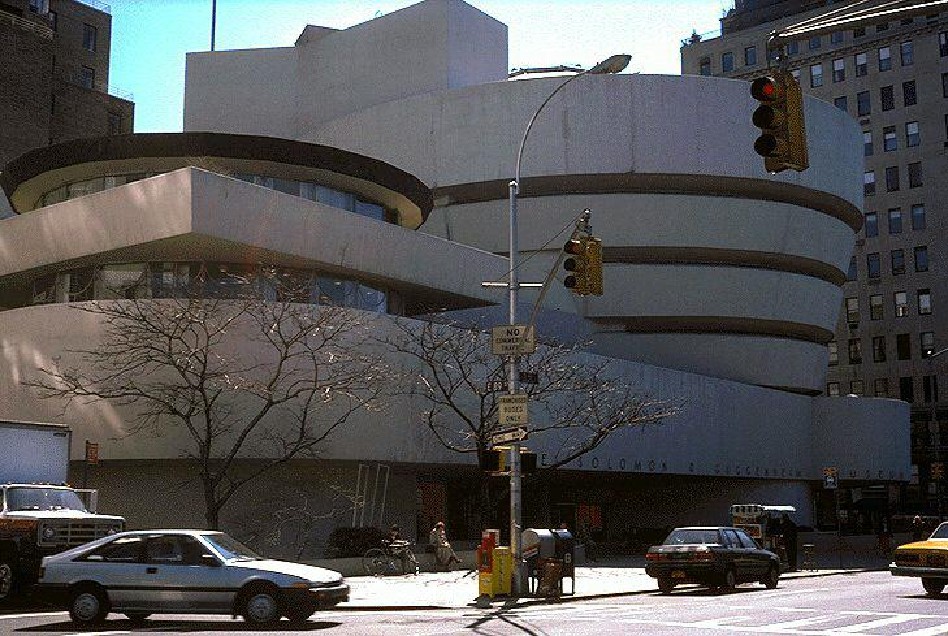
- Frank Lloyd Wright (Guggenheim Museum, New York)
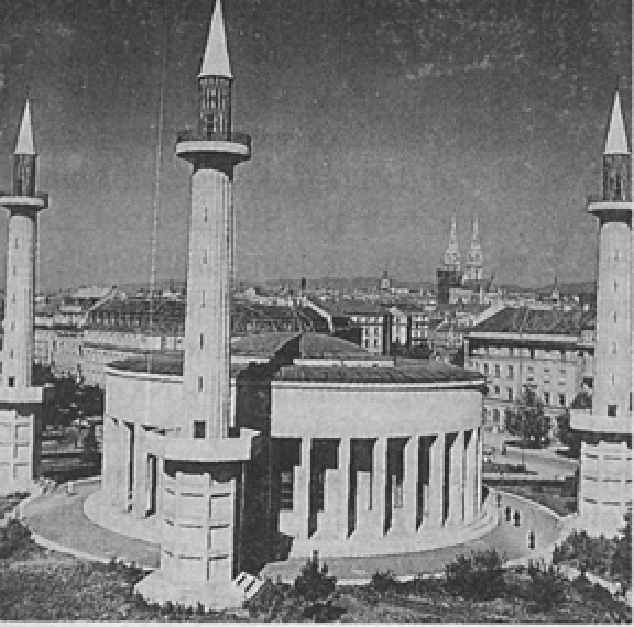
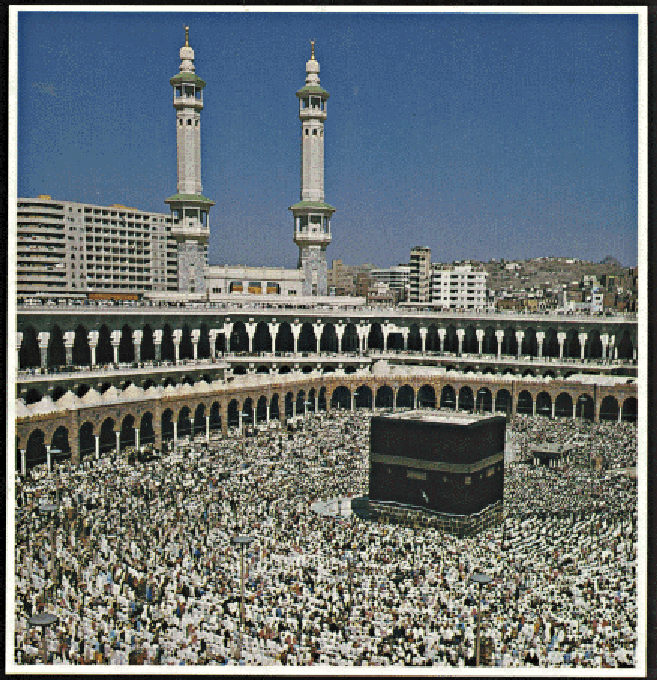
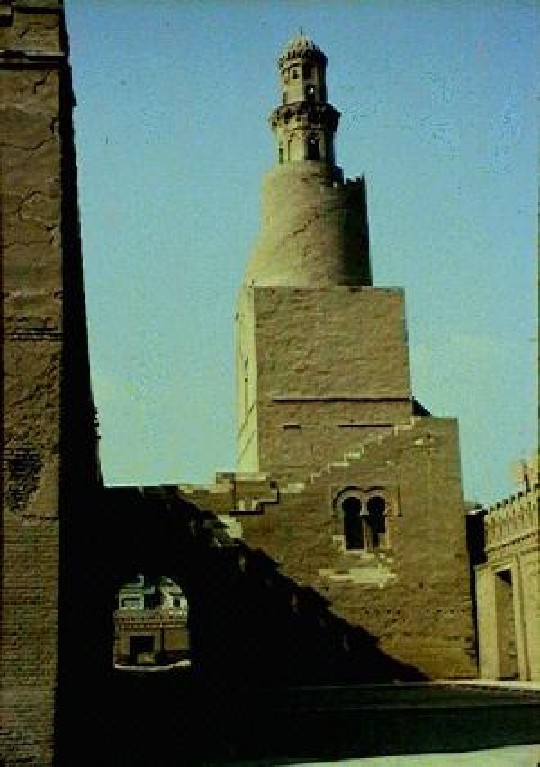
- Islamic architecture in general (especially Moorish)
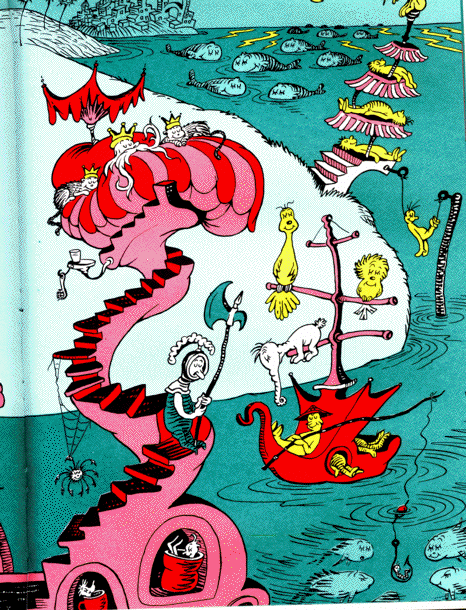
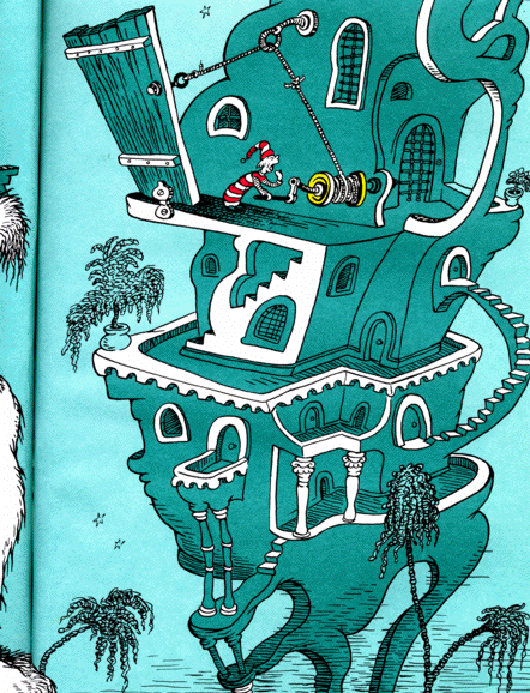
- Compare with later Dr. Seuss buildings (from The Sleep Book)
- Lots of examples of people drawing upon Dr. Seuss for inspiration/material